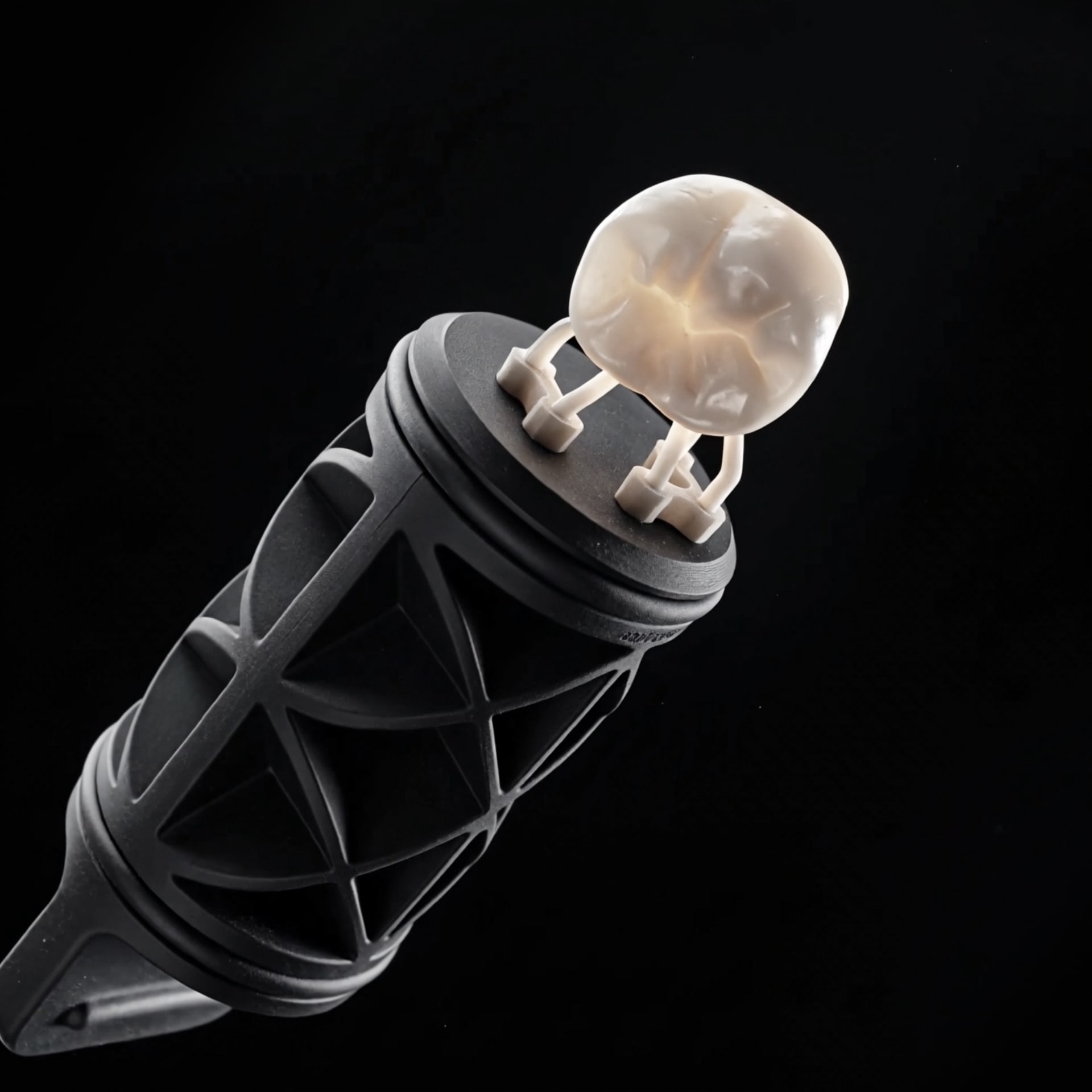
SprintRay has announced the commercial launch of Midas Restore™, an FDA-cleared, ceramic- and zirconia-filled definitive restorative resin developed for use with the company’s Midas Digital Press. The material is indicated for the fabrication of definitive crowns, inlays, onlays, and veneers using a chairside digital workflow.
Midas Restore contains more than 75% filler by weight, combining glass ceramic and zirconia in a resin formulation intended to provide strength, wear resistance, polish retention, and optical properties appropriate for definitive restorations. According to SprintRay, the material was developed with consideration for how a restoration polishes, wears, flexes, and functions after adhesive bonding to remaining tooth structure.
"Traditional dental 3D printing forces a compromise: the material has to be fluid enough to print, which limits how highly filled it can be," said Amir Mansouri, CEO and Founder of SprintRay. "Midas Restore was designed in our material science lab to address that limitation. By pairing a highly filled glass ceramic and zirconia formulation with Midas Digital Press, we can give clinicians access to a new class of definitive restorative materials and bring them into an efficient same-visit workflow."
Material Properties and Performance
The resin matrix of Midas Restore is designed to help arrest crack propagation, and its flexural modulus is intended to more closely approximate dentin than glass ceramic. When adhesively bonded, the material is designed to function together with the remaining tooth structure to distribute functional stresses.
In SprintRay laboratory testing, Midas Restore retained 98% of its initial gloss after 5,000 simulated toothbrush-abrasion cycles and demonstrated five times the wear resistance of SprintRay Ceramic Crown over 200,000 cycles. The company reported that this wear performance was comparable to that of a milled hybrid ceramic.
In biaxial flexural testing, Midas Restore achieved a maximum strength of 215 MPa, with a mean of 180 MPa.¹ Surface hardness was reported at greater than 80 HV, which SprintRay stated was statistically equivalent to a leading nanofilled direct composite and approximately twice that of previous-generation printed restorative resins. The material has a reported translucency parameter of 13.5 for shade A1, placing it within the range of milled lithium disilicate HT.²
"We engineered Midas Restore around how a restoration actually behaves once it is bonded to a tooth, not around a single strength number," said Hossein Bassir, Chief Product Officer at SprintRay. "Filler content, polish retention, wear resistance, modulus and optics are not separate features. They are one system, and the tooth is part of it."
Digital Press Technology
Because highly filled restorative formulations are relatively viscous, they can be difficult to process using conventional vat-based dental 3D-printing approaches. SprintRay’s Digital Press Stereolithography (DPS) technology actively moves the material from sealed capsules into the print zone, enabling the Midas Digital Press to process formulations with filler loads exceeding 75% by weight. Midas Restore is engineered specifically for use with the Midas Digital Press.
The chairside workflow incorporates scanning and design, followed by pressing, post-curing, polishing, and adhesive bonding. Multiple units can be produced from a single capsule. According to SprintRay, restorations can be post-cured in four minutes and polished using two polishing wheels in less than two minutes, without glazing or oven firing. The material also can be adjusted, added to, or repaired intraorally before adhesive cementation.
The Midas Digital Press platform was introduced in 2024. SprintRay reports that clinicians in 33 countries have since produced more than 100,000 restorations using the system.
"With Midas Restore, I can achieve a beautiful, lasting surface gloss in just two or three quick polishing steps with a standard polishing system," said Andrew C. Johnson, DDS, MDS, CDT, FACP, Diplomate of the American Board of Prosthodontics and prosthodontist at OmniSmile Digital Dental Solutions, who participated in the early clinical evaluation of Midas Restore. "That combination of durability, aesthetics and straightforward finishing is what I expect as a clinician from a definitive restorative material. This is an exciting time for digital dentistry."
Availability
Midas Restore became available in the United States on September 1, 2026, in shades A1, A2, A3, B1, and C2. The material is validated for use with the SprintRay Midas Digital Press and SprintRay NanoCure. In the United States, Midas Restore is an FDA 510(k)-cleared (K260661), Class II, prescription-only device.
¹ Maximum value. ISO 6872, piston-on-three-balls. Mean 180 MPa.
² Shade A1; other shades may vary.
Figures and Images
Midas Restore™
